Historic designation sits in the same place in an underwriting workflow as flood zone or construction class. An address goes in, and a yes or no comes out.
A listed building is not priced like an ordinary one. A federal listing marks a building whose replacement cost is not its construction cost, and it frequently travels with local landmark rules and historic district ordinances that impose restrictions on how repairs are made. Carriers use the flag as a screen for that exposure. When the flag is wrong in the direction of a miss, the exposure is still there, just not in the file.
What we tested
We took 109 commercial locations and asked the same binary question about each one: is this building listed on the National Register of Historic Places.
We ran ResiQuant against MapRisk, then checked every answer from both systems against National Park Service register records. Each confirmed listing was recorded with its reference number and a link to the register entry. 31 of the 109 buildings were listed.
The result
ResiQuant found 28 of the 31. MapRisk found 23.
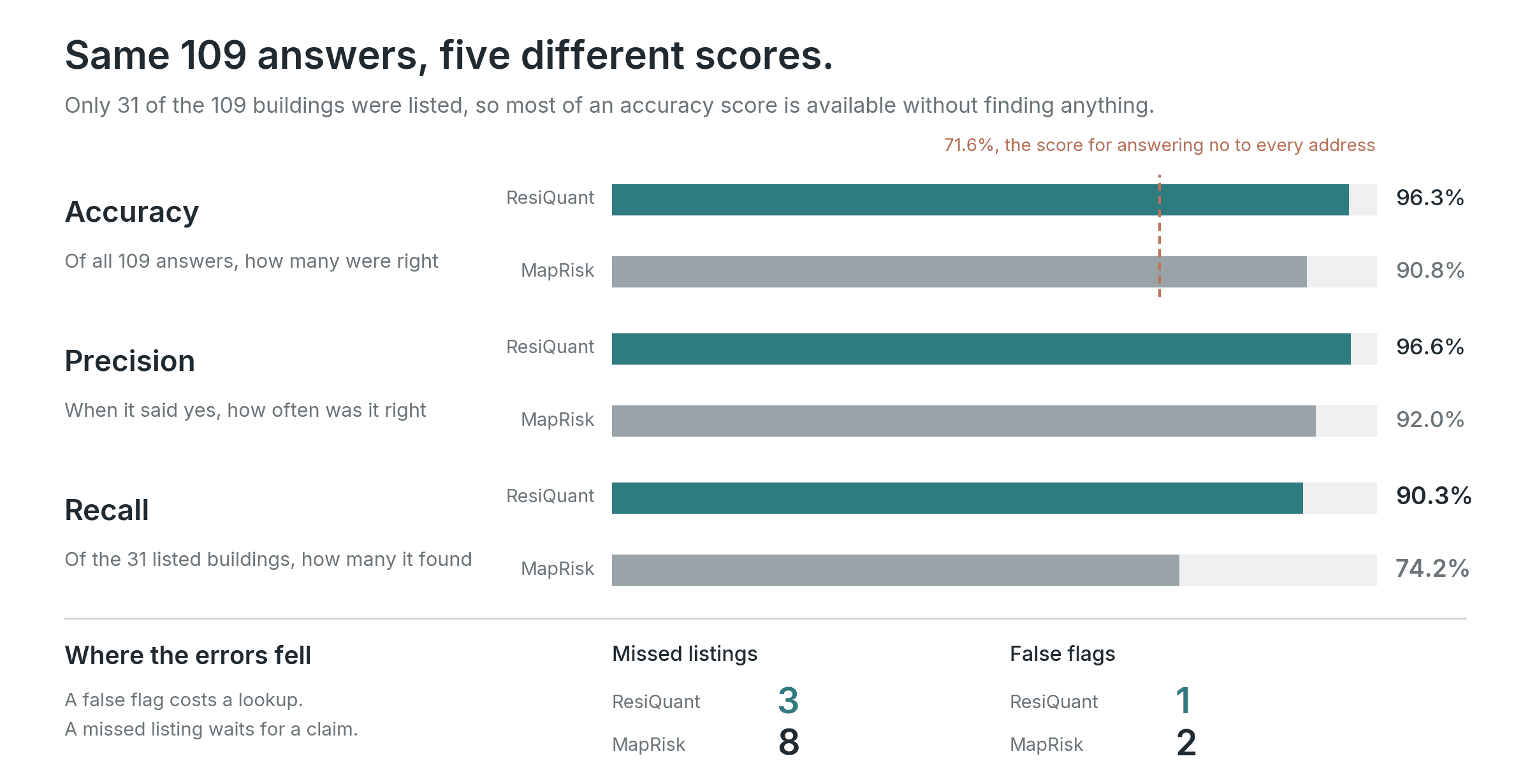
Accuracy isn't quite the right number to look at here. Only 31 of 109 buildings were listed, so a system that answered no to every single address would score 71.6% accuracy without doing anything at all. MapRisk's 90.8% is 19 points above that floor.
Recall is a narrower question but carries the underwriting consequence. Of the buildings that really are listed, how many did the provider find. ResiQuant's recall was 90%, while MapRisk's was 74%.
The asymmetry matters too. A false flag costs an underwriter a few minutes and a lookup. A missed listing costs whatever the restoration exposure turns out to be, and it is not discovered until a claim.
The wrong building
The missed listings from MapRisk split into two groups. Five of the eleven involve a register entry recorded as an address range or a district boundary rather than a single street number, so the submission's address never matched exactly. The remaining six are listings whose address matches the submission precisely, which makes them ordinary misses rather than matching failures.
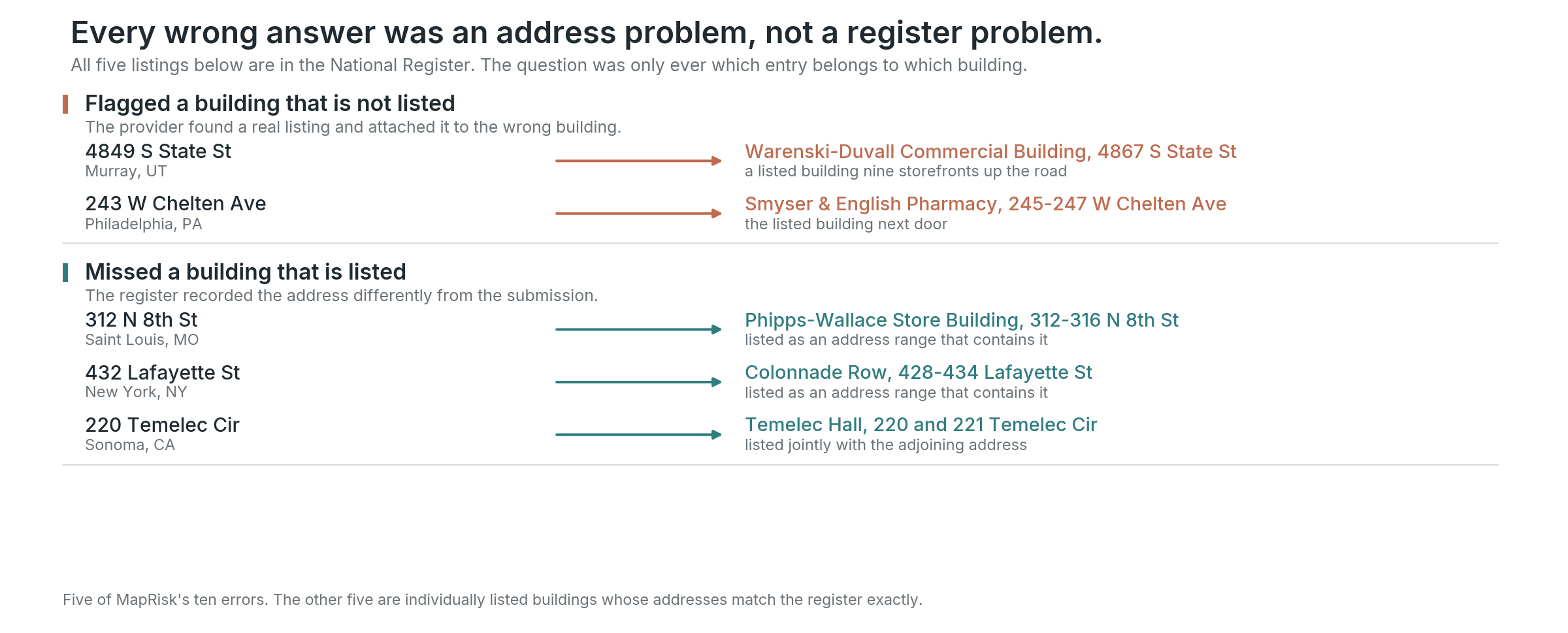
One case shows the shape of it. A provider returned a yes for a commercial building in Murray, Utah. The listing it had found, the Warenski-Duvall Commercial Building, sits roughly nine storefronts up the same road.
The register records buildings, not addresses
Eleven listings were missed across both providers, and five of them share the same cause. The register records the building, not the mailing address. For example, a listing could read 312-316 N 8th St, or 428-434 Lafayette St, or 220 and 221 Temelec Cir. The submission carries one number — 430 Lafeyette St, for example — and it does not always match.
The other six have no such excuse. Those are listings whose register address matches the submission exactly. Nothing had to be inferred or reconciled. The entry was there and it was not found.
What a catch looks like
2083 NW Johnson St in Portland is the American Apartment Building, listed on the National Register in 1993 under reference 93000452. The address on the register matches the address on the submission exactly. There is no range, no district boundary, no adjacent property to confuse it with. MapRisk returned no.
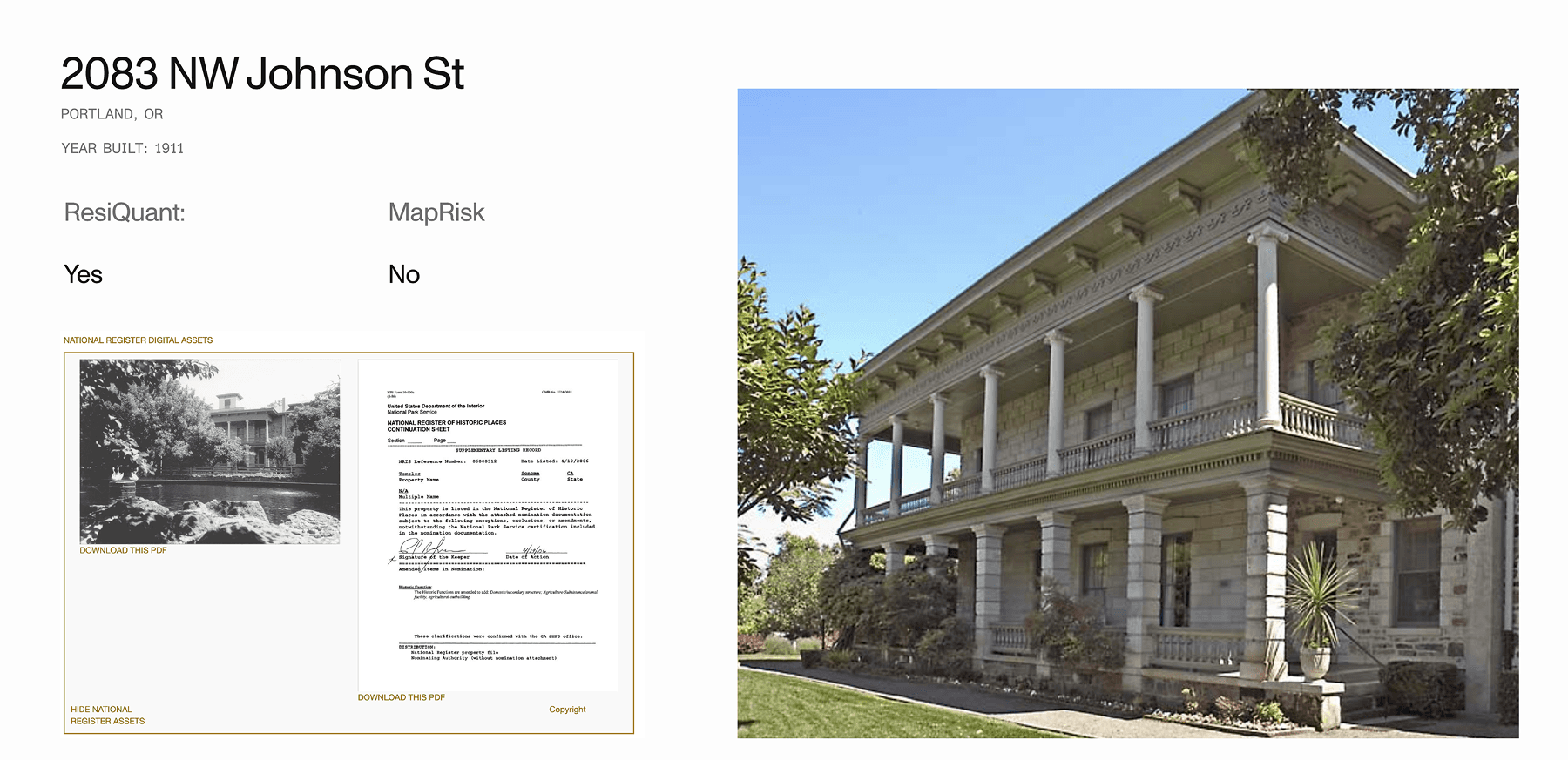
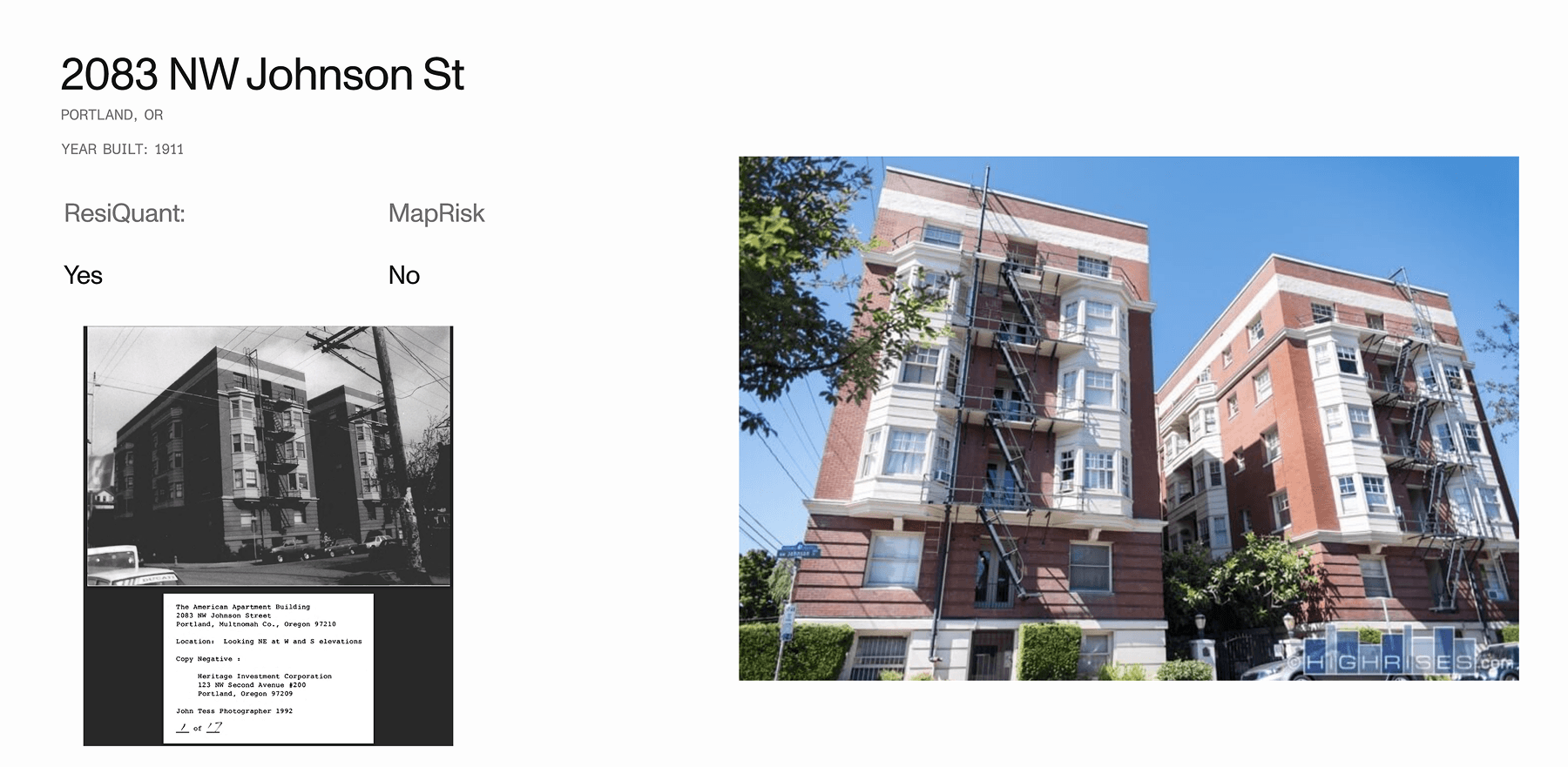
This is the case that should be easiest for any provider. The listing is not obscure, the building is not ambiguous, and the register entry is public.
What this means for a submission
Two findings come out of our study.
The first is that recall is more important than accuracy for a rare attribute. The baseline accuracy for simply guessing no is 72%, so a provider quoting a number in the low nineties is telling you about the base rate more than about the product.
The second is that historic designation is not really a designation problem. Every listing missed in this study is in the National Register. But the register indexes entries by historic property name, not by street address, and an address can be a range, two numbers at once, or a district boundary with no street number at all. Nothing in it carries a parcel identifier.
At ResiQuant we’ve built Engineering AI to treat cases like this as an entity resolution problem rather than a simple record lookup. It establishes which physical structure an address denotes, then determines whether the building a register entry describes is that same structure, weighing construction, age, footprint and historic name alongside the address itself. Designation is one of the fields that resolution produces. It is also what puts a roof age, a construction class, or a year built on the right building.