For an underwriter pricing wind exposure, roof age is one of the most consequential fields on a submission and a major component of pricing. The roof is the part of a building a hurricane stresses most, and a worn one fails at wind speeds that a sound one would survive, yet a roof gets replaced on its own schedule while the structure beneath it does not.
We wanted to test ResiQuant against other leading providers, so we took a set of properties from real submissions and asked ResiQuant’s Engineering AI, SpatialKey, and BuildFax the same question: How old is the roof?
How the test was conducted
Every answer was checked against historical satellite imagery. For each property, the imagery was reviewed year by year by a human to find the point where the roof visibly changed. The results was also cross-checked other sources of data like permits when available. The results of that analysis became the ground truth. Where no change was visible in the available imagery or documentation, the answer was defaulted to the building's year built.
The results
We scored every answer three ways, from an exact match on the year out to a two-year tolerance.
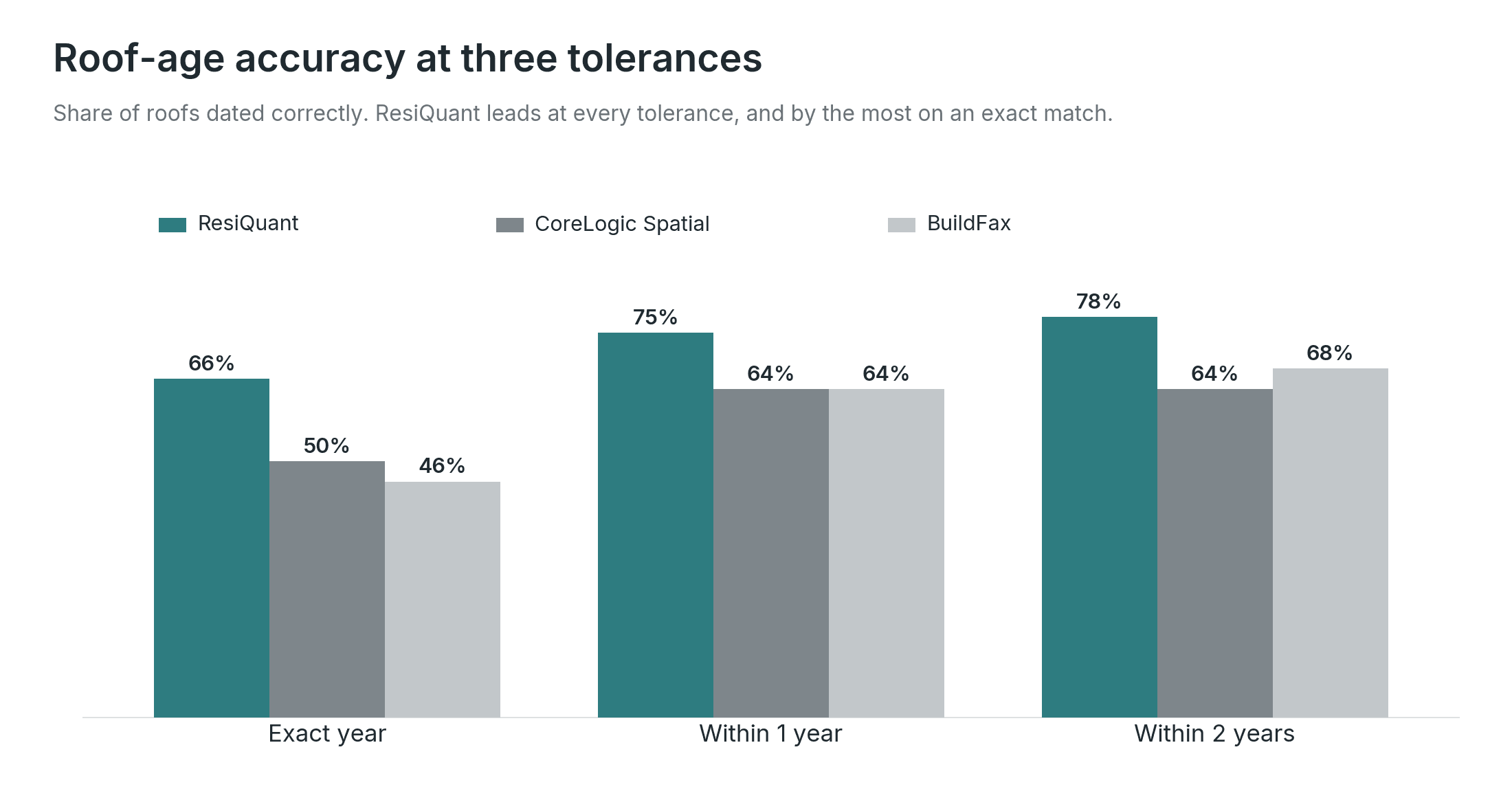
ResiQuant leads by sixteen points on exact match, eleven at one year and nine at two, and the compression continues as the band widens further. A wider tolerance raises every score and narrows the distance between them, which is worth knowing when a provider quotes an accuracy figure without stating the tolerance behind it.
Pre-2000s properties
On 14% of the properties, the imagery showed no roof change at any point in the available record. There was no year to record, so the reference answer for those rows is older than 2000.
ResiQuant also answers older than 2000 on those, and matches all of them. SpatialKey never returned that category at all, and BuildFax returned it once. So 14% of this test is a category that ResiQuant uses and the other two mostly do not.
That said, the two providers did not decline to answer those rows. They answered, and they were wrong. Of the properties whose roofs show no change since 2000, SpatialKey placed nearly 80% of them in 2020 or 2021. BuildFax placed 64% of them in 2000 or 2001. Those are assertions that a roof was recently replaced, on properties where the evidence shows the same roof throughout.
Which direction a miss runs
Accuracy treats every error the same, but errors are not equal in an underwriting workflow.
Being told a roof is older than it is costs margin. If you price for a replacement that is not due, you lose the account to someone who priced it correctly. Being told a roof is newer than it is costs a claim. You price a twenty-five-year-old roof as though it has twenty years left, and you find out at the loss.
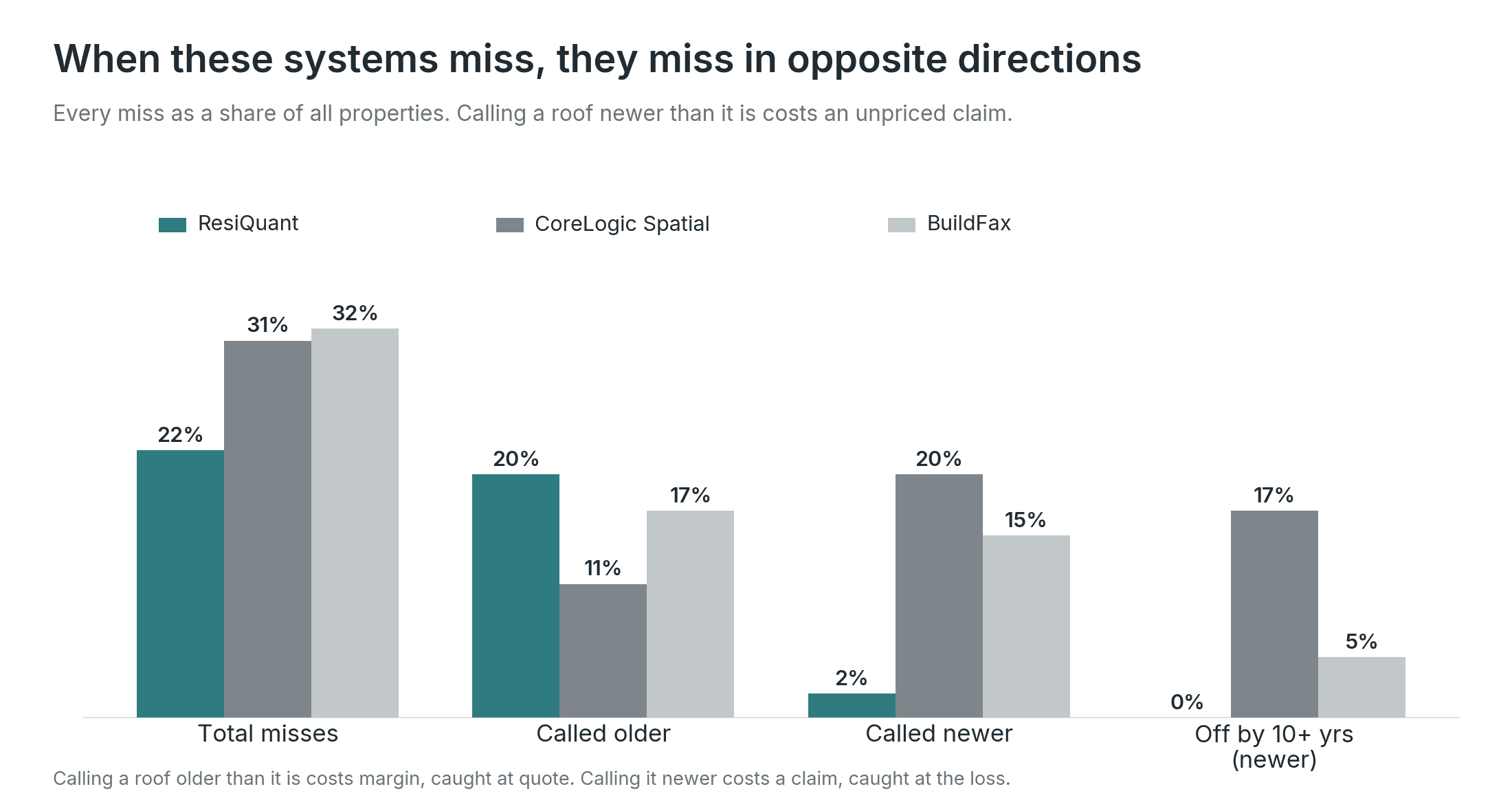
ResiQuant has no dangerous misses on this test. Not one property where it called a roof a decade or more newer than the imagery shows. Roughly 90% its errors run toward calling a roof older than it is, which is the direction that costs some margin rather than an unpriced claim.
SpatialKey has a 17% rate of 10+ year misses, and 11% of those roofs had no visible replacement in the entire imagery record.
What we are still working on
Two thirds of the time ResiQuant’s Engineering AI gives an exact year for roof age. That leaves a third where it does not.
14% of properties in this sample got an answer of older than 2000 correctly, and a similar share got the same answer when the roof had in fact been replaced after 2000. Narrowing that second group is the work, and it means finding evidence of replacement in cases where the imagery is inconclusive, which is where permit records, listing history and construction detail have to carry more of the weight.
Roof age will never come from a lookup, because for most properties there is nothing to look up. It has to be observed, and observation has limits that a data field does not. An underwriter should focus not only on how often a provider it is right, but which way it fails when it is wrong.