On June 24, 2026, two earthquakes struck northern Venezuela 39 seconds apart — a magnitude 7.2 foreshock and a magnitude 7.5 mainshock near Yumare, in Yaracuy state. It was the strongest earthquake to hit the country since 1900, it sent strong shaking into La Guaira and Caracas, and as of today it has claimed at least 1,700 lives [1]. The photographs of collapsed concrete apartment blocks are difficult to look at [2].
A partner in the insurance industry asked us this week how California would respond to similar shaking. It is a question worth answering carefully. Venezuela has had a formal seismic code for more than forty years, descended from the same engineering tradition California uses, which makes the two codes close cousins. The gap in outcomes, then, is not a story about the code, and the nuance is important.
Understanding what drives a difference in outcomes requires separating the seismic hazard — the shaking the ground can produce — from the four factors that determine how a building performs under that hazard:
Code publishing — is a modern seismic standard written?
Code adoption — is it the law, and how long after it is published?
Code enforcement — is it actually applied to the buildings, new and existing?
Construction practice — what gets built, and out of what materials?
Venezuela and California are very alike on the first two factors and diverge on the last two, and that divergence largely determines how the West Coast would fare under a comparable seismic event.
1. The hazard is genuinely comparable
Start with the ground itself, because this is where the comparison is strongest. Northern Venezuela and California are tectonic cousins. Both sit on strike-slip transform plate boundaries (Figure 1). In Venezuela, the Caribbean plate grinds eastward past South America at roughly 20 mm/year [3], a motion absorbed by the Boconó, San Sebastián and El Pilar faults. A 1972 study of western Venezuelan tectonics explicitly described the Boconó as a strike-slip system analogous to the San Andreas [4]. The June 2026 earthquakes were textbook strike-slip ruptures on this boundary.
The hazard numbers line up. Venezuela's code sets the design ground motion in Caracas at about 0.3 g of peak acceleration on rock for a 475-year return period [5]; Los Angeles and San Francisco sit around 0.4–0.5 g for the same return period[6]. California's can produce, and historically has produced, larger events (the 1857 Fort Tejon and 1906 San Francisco earthquakes were both about M7.9) [6]. But Venezuela is no stranger to great earthquakes. The 1812 Caracas earthquake (about M7.5–7.7) claimed an estimated 10,000–20,000 lives [7], and the El Pilar fault last produced a roughly M7.5–7.8 event in 1766 [8]. A structural engineer analyzing the two hazard curves without labels would classify each as "high seismic."
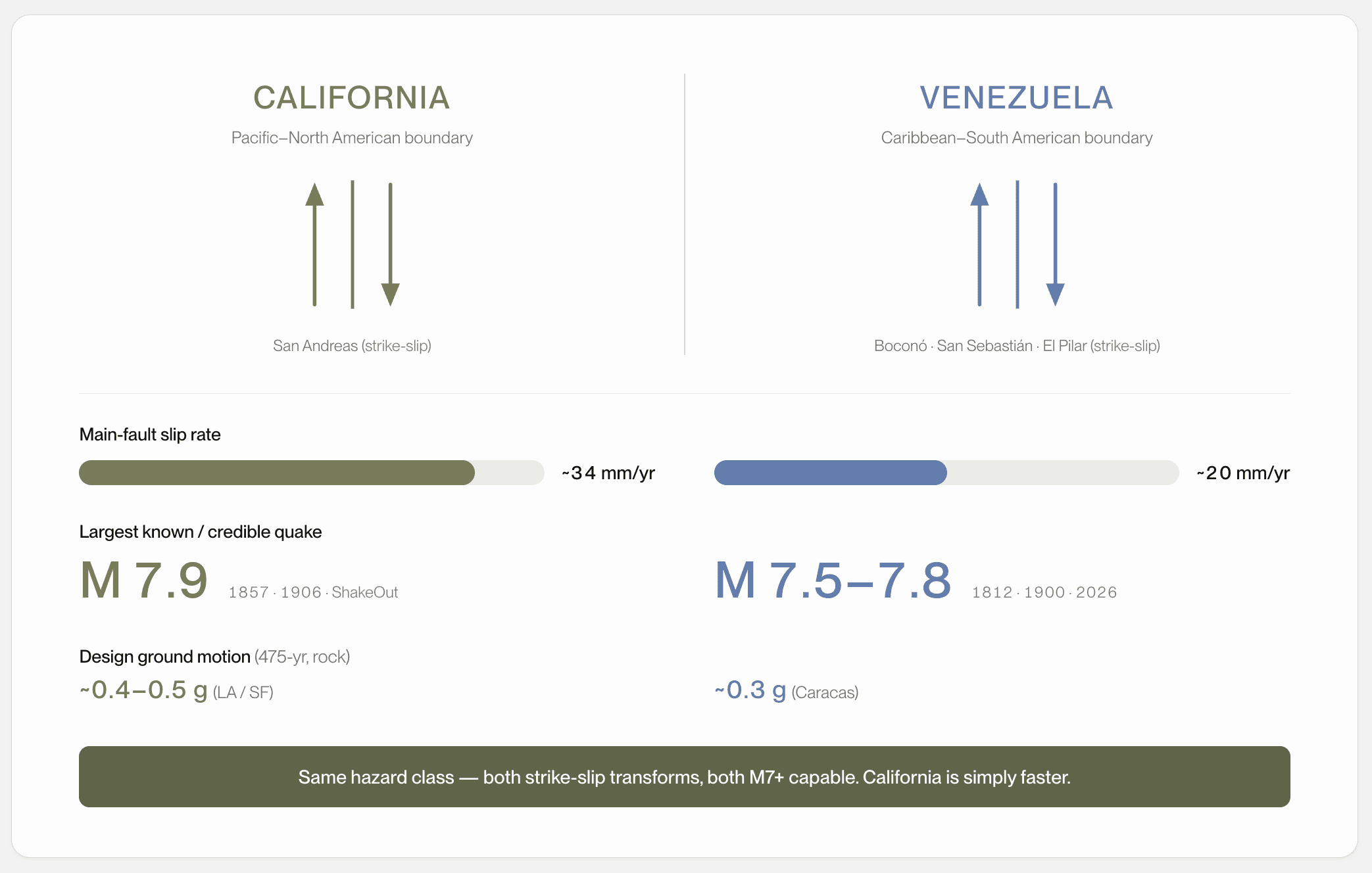
Figure 1 — Two strike-slip boundaries. Both regions sit on continental strike-slip transform plate boundaries. California's San Andreas system moves faster (about 34 mm/yr on the main strand, about 46 mm/yr total plate motion) than Venezuela's (about 20 mm/yr, split across the Boconó, San Sebastián and El Pilar faults), so it loads strain and recurs more often. Both are unambiguously high-seismic, M7+ regions with the same order-of-magnitude design ground motion.
2. The code: published, adopted, and enforced
Whether a country has a building code is, on closer inspection, three separate questions. Was the code published? Was it adopted? And was it enforced? Conflating the three leads to a misunderstanding of the actual situation.
Publishing the code
Venezuela has had a formal seismic-resistant design standard, COVENIN 1756, since 1982. It was revised in 1998/2001 and again in 2019, and the current edition (COVENIN 1756-1:2019) is technically modern. It includes site classification, near-fault effects, liquefaction, and a chapter on evaluating and strengthening existing buildings [5][9]. Crucially, it descends from the same engineering tradition as the California code (Figure 2). California's lineage runs from the SEAOC recommendations through the ATC and NEHRP provisions into today's ASCE 7 and ACI 318 [10]; Venezuela's COVENIN code was built on that same foundation. In design philosophy, the two codes are essentially equivalent. Both were also motivated by devastating earthquakes. Just as the 1971 San Fernando earthquake gave U.S. concrete its first ductile detailing rules [10], the 1967 Caracas earthquake created Venezuela's seismological agency (FUNVISIS, 1972) and set its first code in motion [5].
One point matters enormously for insurers and is true on both coasts: a building code is a life-safety floor, not a damage-prevention standard. A code-compliant building is designed so the people inside can get out. It is explicitly permitted to be damaged, sometimes beyond economic repair. "Built to code" therefore still means "built to be damaged." Neither the Venezuelan nor Californian codes were written to prevent loss, only casualties.
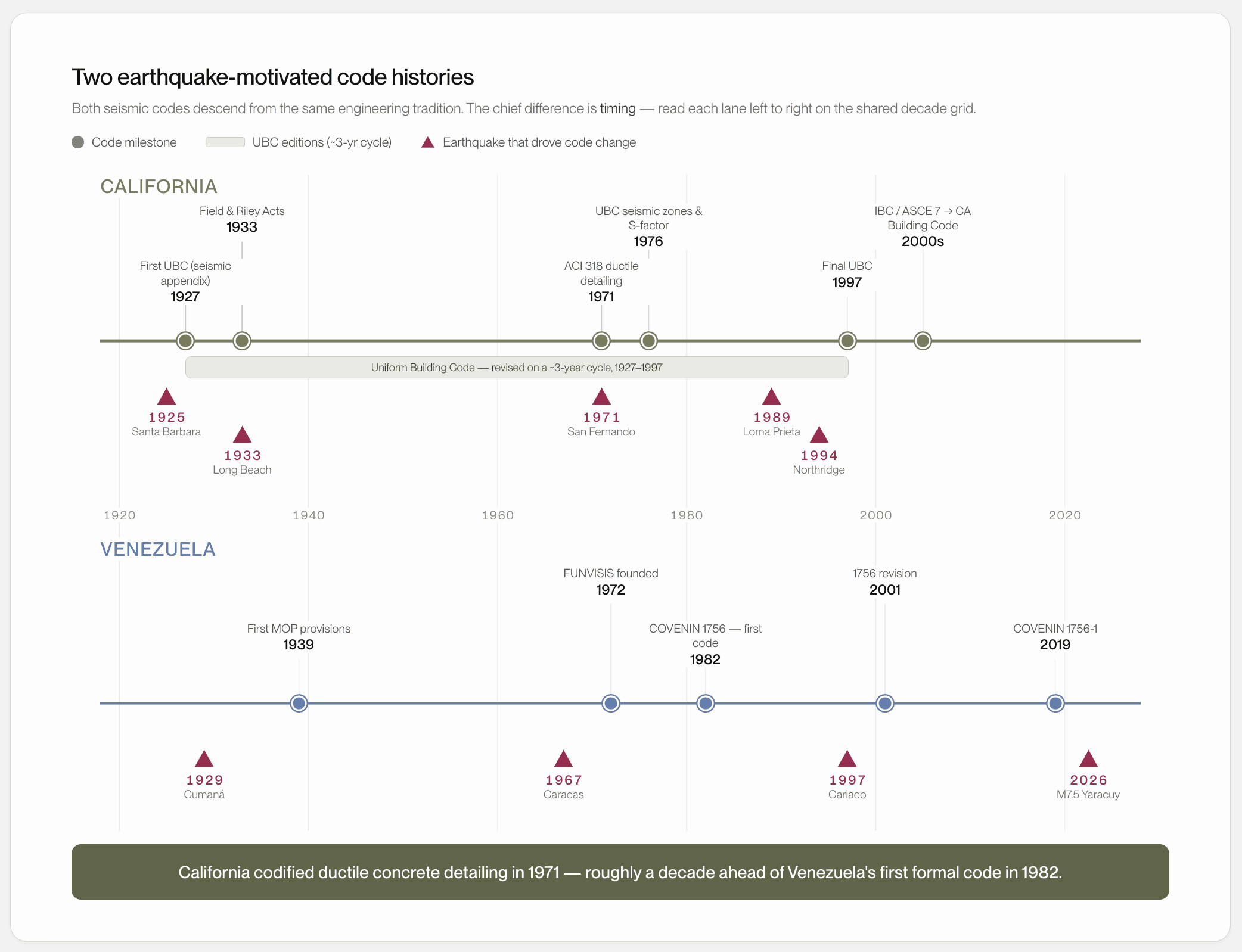
Figure 2 — Two earthquake-motivated code histories. California's Uniform Building Code was published on a steady ~3-year cycle from 1927 to 1997 before transitioning to the IBC / ASCE 7 and the California Building Code; Venezuela's COVENIN 1756 descends from that same body of practice. The chief difference is timing: California codified ductile concrete detailing in 1971, about a decade ahead of Venezuela's first formal code in 1982.
Adopting the code
Adoption of the code is a legal question: Once a code is published, how long until it is law? Here the two systems differ in structure more than in quality. Venezuela adopts its code centrally. A single national body issues COVENIN 1756 for the whole country at once. The 2019 edition, for instance, was formally approved roughly a year after it was finalized [9]. California, for most of the 20th century, did the opposite. The Uniform Building Code was a model code, and each city and county adopted it by local ordinance on its own schedule. This means that a given edition could take several years to become law in one jurisdiction while a neighbor still ran an older version [10]. Only after the statewide California Building Standards Code (Title 24) matured did adoption tighten to a uniform cycle. Today a new edition is published and becomes effective within roughly six months to two years statewide [11]. This all means that a published code is not an enforced code, and the lag between the two can be substantial in both regions.
Enforcing the code
This is where Venezuela and California start to diverge. For new construction, California enforces its code about as completely as a system can. Every permitted building passes mandatory plan-check and inspection, and the state's building-code-effectiveness grade is among the strongest in the country [12]. Venezuela, by contrast, is estimated to have fewer than 25% of its construction in compliance with the seismic standard, the gap driven largely by limited inspection capacity and an enormous informal, self-built housing sector that never enters the permitting system [13]. And even on formally engineered Venezuelan projects, a 2004 study found conceptual errors in the lateral-load-resisting systems of new buildings at a "near-universal" level. This includes soft stories, short columns, and ignored infill walls [14].
But California's enforcement has a large blind spot in existing buildings. New-construction rigor does nothing for the millions of structures built before the modern code. California's retrofit of that legacy stock is badly incomplete (a point we return to below).
The World Bank's resilience program puts it bluntly: "the simple transfer of building codes from highly developed to developing countries is often counterproductive." What protects buildings is not the code text, it is the regulatory machinery that turns text into built reality [15].
3. Construction practice: concrete versus wood
The fourth factor is what people actually build, and with what material. This is the most visible difference apparent in the photographs from Venezuela.
Venezuela is a concrete-and-masonry country (Figure 3). The characteristic building is a reinforced-concrete frame with unreinforced clay-tile or masonry infill, two to several stories, very often owner-built. Roughly 70% of Venezuelan housing has been constructed informally, and a majority of the urban population lives in self-built barrios [16]. Timber framing is essentially absent; engineered steel is rare outside industrial and commercial buildings. This concentrates collapse risk in exactly the system that fails most often — non-ductile concrete frames with soft stories, short columns, and plan irregularities. We have seen this before. In both the 1967 Caracas and 1997 Cariaco earthquakes, concrete buildings collapsed from soft-story and torsional failures [8]. The 2026 images show the same failure mode (Figure 4).
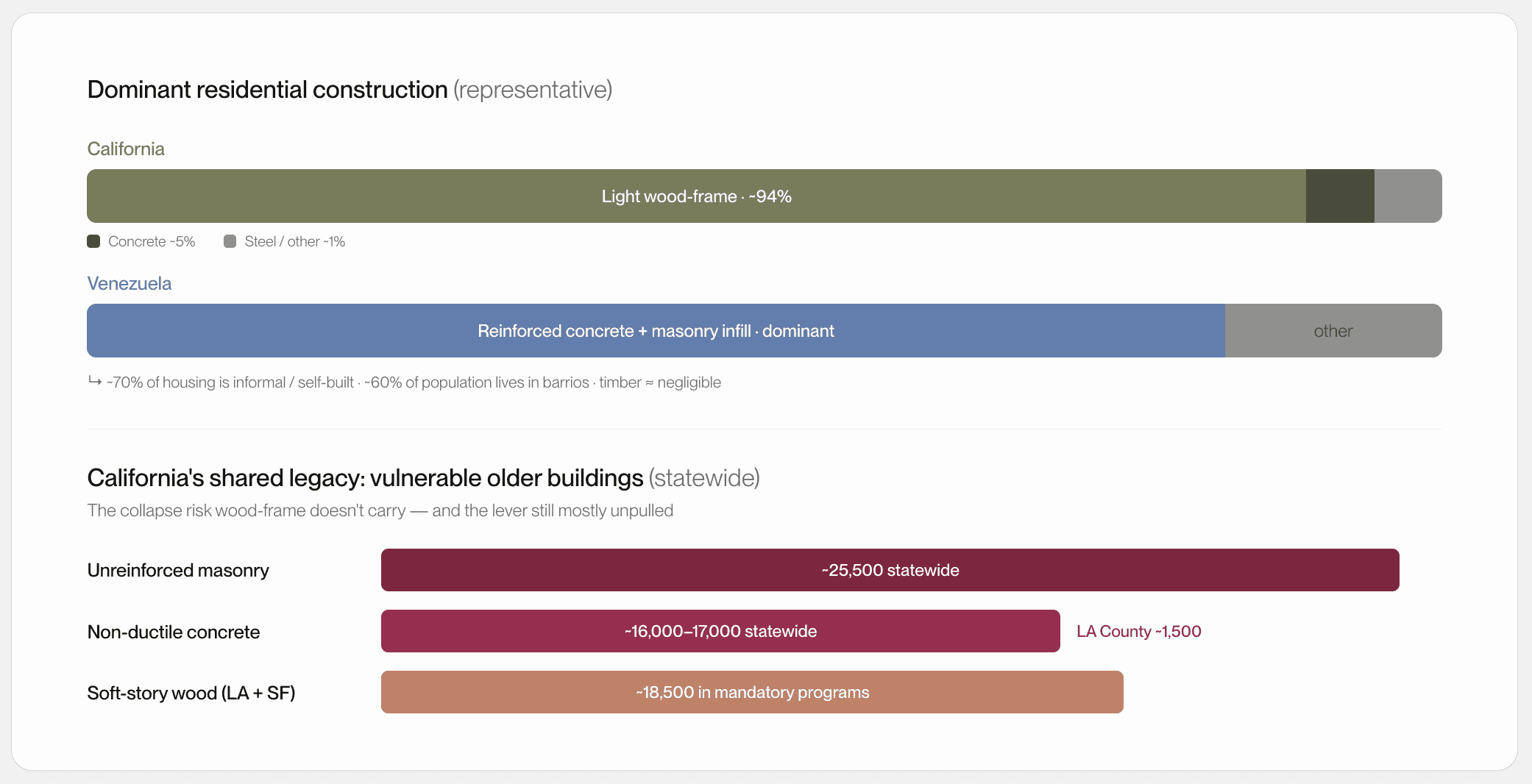
Figure 3 — Distribution of constructions materials in Venezuela and California.
California builds with wood (Figure 3). About 94% of California homes are light wood-frame [16]. This is an advantage in earthquakes, but not because wood-frame buildings are collapse-proof. They are not. Soft-story and cripple-wall failures are widespread and well documented [17]. The advantage is mass. A wood building weighs a fraction of an equivalent concrete one, so even when it fails, it imposes lower life-safety risk on its occupants than a collapsing concrete frame or masonry wall does. The risk that does not get diluted by all this is the concrete.
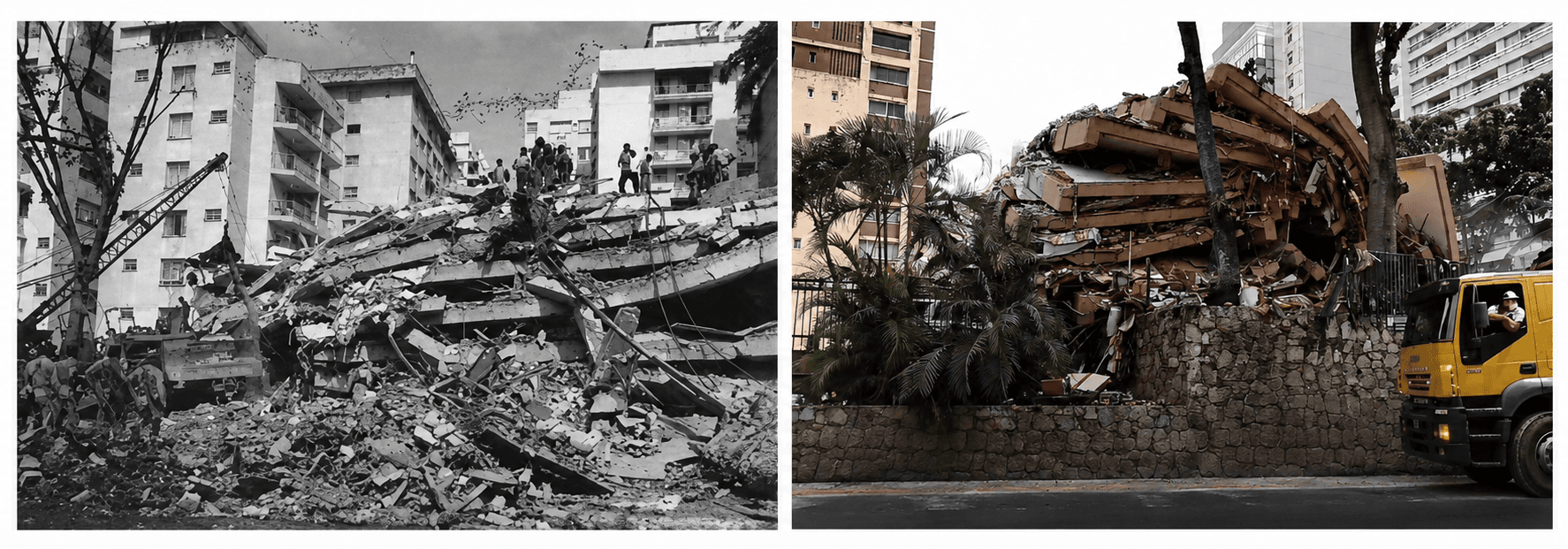
Figure 4 — The same collapse, sixty years apart. The 1967 Caracas earthquake (left: via FII.gob.ve) — the event that motivated formal seismic design in Venezuela — produced collapses that look almost identical to the photographs from June 2026 (right: via CNN), nearly sixty years apart. The same has already been seen in California, for example after the 1994 Northridge earthquake, and still there are thousands of concrete buildings, waiting for an earthquake we know is coming. The difference between watching this happen and preventing it is not knowledge — we have the inventory and the engineering.
4. What this means for California
The buildings collapsing in Caracas and La Guaira are mostly non-ductile reinforced concrete, designed before modern ductile detailing, whose columns shatter instead of bending. California holds a large stock of the same type. Roughly 16,000 to 17,000 of these buildings stand across its highest-seismicity counties — not only in Los Angeles, where the city's own inventory runs about 1,500 [18][19] — and the large majority have never been retrofitted.
Our own analysis of more than 29,000 retrofit permits filed in the City of Los Angeles between 1994 and 2025 makes the gap vivid [17]. The cheap, high-volume work moves: cripple-wall and soft-story retrofits account for the overwhelming majority of permits. But the deadliest types — unreinforced masonry, non-ductile concrete, and older steel moment frames — together account for fewer than 500 permits over 31 years. Los Angeles' non-ductile concrete program has completed retrofit on only about 6% of its buildings, with a compliance window that stretches into the 2040s [20], and most California jurisdictions have no concrete ordinance at all. The deadly stock is barely moving despite that very similar collapses to those observed in Venezuela have already happen in California (Figure 5).
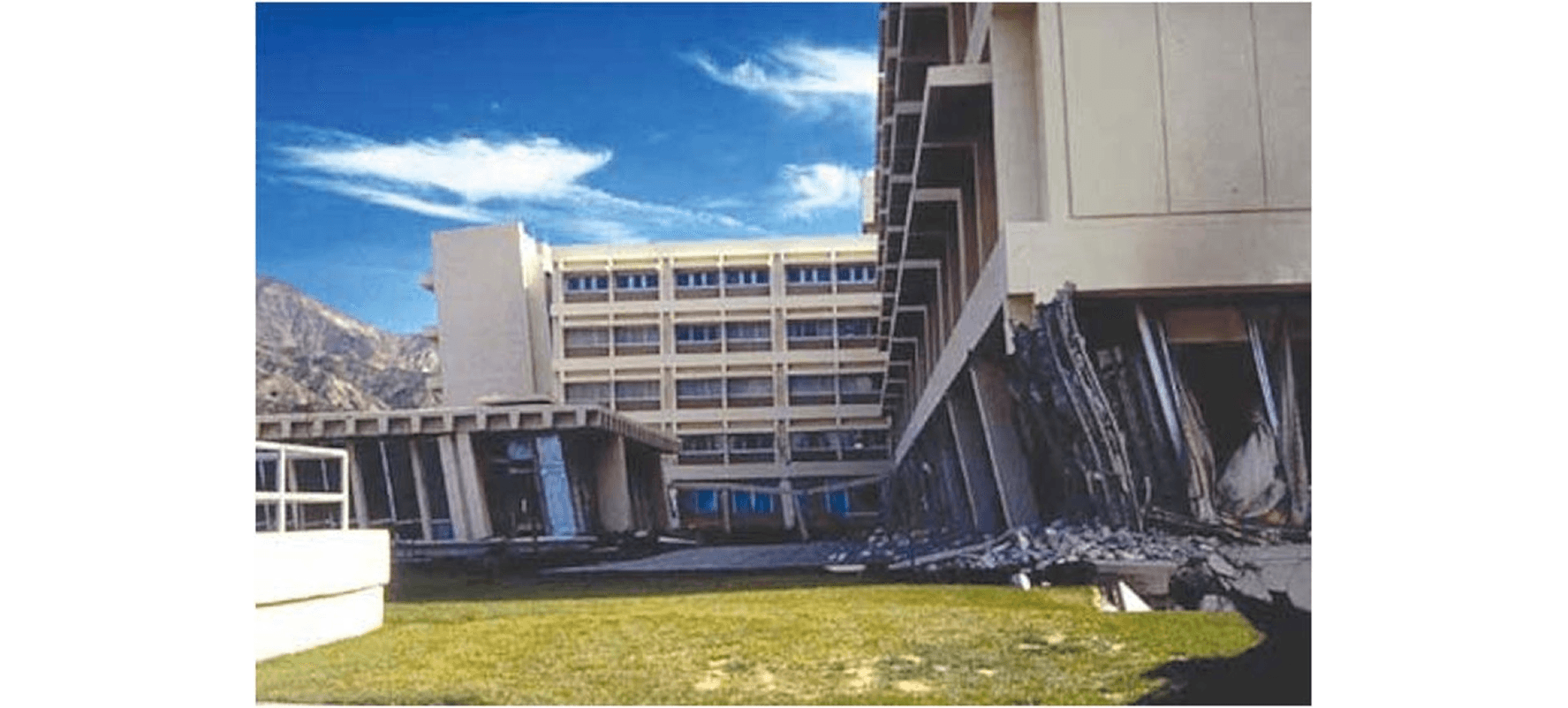
Figure 5 — California has already seen this. RC soft story failure of a Hospital during San Fernando EQ. (via ResearchGate)
The mechanism that moves this legacy stock at the pace society needs is financial more than regulatory. Today risk is too often priced by ZIP code, which systematically misprices the individual building [17]. When an insurer can tell, building by building, which construction class a property belongs to and whether it has actually been retrofitted, a retrofitted building can be priced for the genuinely lower risk it now carries, and that lower price is something the owner earns by doing the work. A retrofit stops being a pure cost and becomes an investment with a return, which gives owners a reason to act before an earthquake forces the issue. The engineering and the inventory already exist. What has been missing is an incentive for owners to move, and pricing the risk accurately at the level of the individual building is one way to supply it.
Venezuela is a tragedy unfolding in real time. California has been warned the same way before, by its own earthquakes and by the thousands of older concrete buildings it has already counted and not yet fixed. The task now is to act on what we already know is dangerous, before any more lives are lost.
References
2026 Venezuela earthquakes — USGS; event summaries (CNN, Wikipedia).
https://visualizers.aiforgood.ai/damage-assessment/venezuela_earthquake_2026_report.html
Dewey, J.W. (1972). Seismicity and Tectonics of Western Venezuela. BSSA 62(6):1711–1751.
USGS — 2023 National Seismic Hazard Model; San Andreas fault / ShakeOut scenario.
Audemard, F.A. (1997, 2006). Boconó fault system / Quaternary faults of Venezuela (neotectonics).
COVENIN 1756-1:2019; approved by FODENORCA, 22 May 2020.
Uniform Building Code publication history (ICBO); UC Berkeley Library Guides — building codes.
ISO / Verisk — Building Code Effectiveness Grading Schedule (BCEGS); California grade.
World Housing Encyclopedia — Venezuela; USGS PAGER building inventory; NAHB wood-frame share.
ResiQuant (2026). Thirty Years of Seismic Retrofit Permits — 29,000+ LA permits, 1994–2025.