Twenty-seven years after the 1999 disaster in the same city, a new reconnaissance report examines what changed in the 2026 event—and where catastrophe losses are moving.
The full report is available here.
The report is also available in Spanish here.
On August 10, 2026, a magnitude 7.4 earthquake struck beneath western Colombia. Today we are publishing a detailed reconnaissance study of what it did to the city of Armenia, capital of the Quindío department in Colombia's coffee-growing region, and how that outcome compares with the earthquake that impacted the same city twenty-seven years earlier.
On January 25, 1999, a smaller magnitude earthquake—but one that ruptured almost directly beneath Armenia—killed 907 people in the city alone, out of at least 1,185 across the region. Around 60% of the city's buildings were damaged. Three hospitals collapsed. So did the central fire station, killing trained officers and destroying the city's heavy rescue equipment.
In 2026, in a city that had grown larger, taller, and denser, no one in Armenia died.
The same city, two damaging earthquakes within a single generation, with instrumental recordings of both. It is an unusually clean natural experiment, and it is rare that anyone gets to run it.
About the study
The report is the product of a cross-institutional collaboration bringing together researchers from ResiQuant, Universidad de los Andes, the Barcelona Supercomputing Center in Spain, CentraleSupélec in France, and Guy Carpenter.

The field team was on the ground from the day of the earthquake through the following Sunday—to our knowledge, the first reconnaissance and volunteer inspection team to operate in the city. Working in support of the municipalities of Armenia and Calarcá, two structural engineers inspected 35 buildings in detail and issued occupancy recommendations that local authorities and residents used to decide what was safe to enter.
The published study combines those inspections with the municipality's full tagging database of 2,460 buildings, a comparison of the ground shaking recorded during both earthquakes at the one instrument in Armenia that captured them both, and a review of how Colombia's building codes and construction practice evolved across the twenty-seven years between the events.
What the report finds
The building codes worked. The two earthquakes were not the same event twice—the 1999 rupture was shallow and close, while the 2026 rupture was far larger but much deeper and further away. Armenia felt roughly half the peak ground acceleration in 2026, but the shaking lasted about five times longer. It was not simply a gentler earthquake; it was a different kind of demand, and in some respects a harder one.
Critically, the shaking was strong enough to genuinely test the city. The recorded motion met or exceeded what the older building codes had asked designers to protect against, and reached the edge of what the current code requires. This was not a near miss. With a bigger, denser city exposed than in 1999, the outcome cannot be explained by luck or weaker shaking. It reflects a real reduction in how vulnerable the buildings are—the accumulated result of successive building codes, the post-1999 reconstruction program, and better construction practice. That is a genuine public-safety success!
But the loss moved. Lives were protected. Structural damage was largely prevented. What was not prevented was disruption.
The skeletons of these buildings—the columns, beams, and walls that carry the loads—mostly survived without damage. What failed was what was attached to them: interior partition walls that cracked and lost stability, parapets and gable walls that detached from buildings they had never been properly anchored to, façade panels that fell onto sidewalks, ceilings that came down, masonry ducts that failed and flooded the floors below. Buildings whose frames were essentially undamaged were evacuated in full, because loose material overhead was an immediate hazard to anyone walking underneath.
Of the 2,460 buildings the municipality inspected (Figure 1), roughly a quarter were tagged unsafe to occupy and about a third were placed under restricted use. Those figures describe the inspected set—buildings flagged for assessment because damage was suspected — not the city as a whole. But they show clearly where the consequences landed, and it was not in collapsed structures.
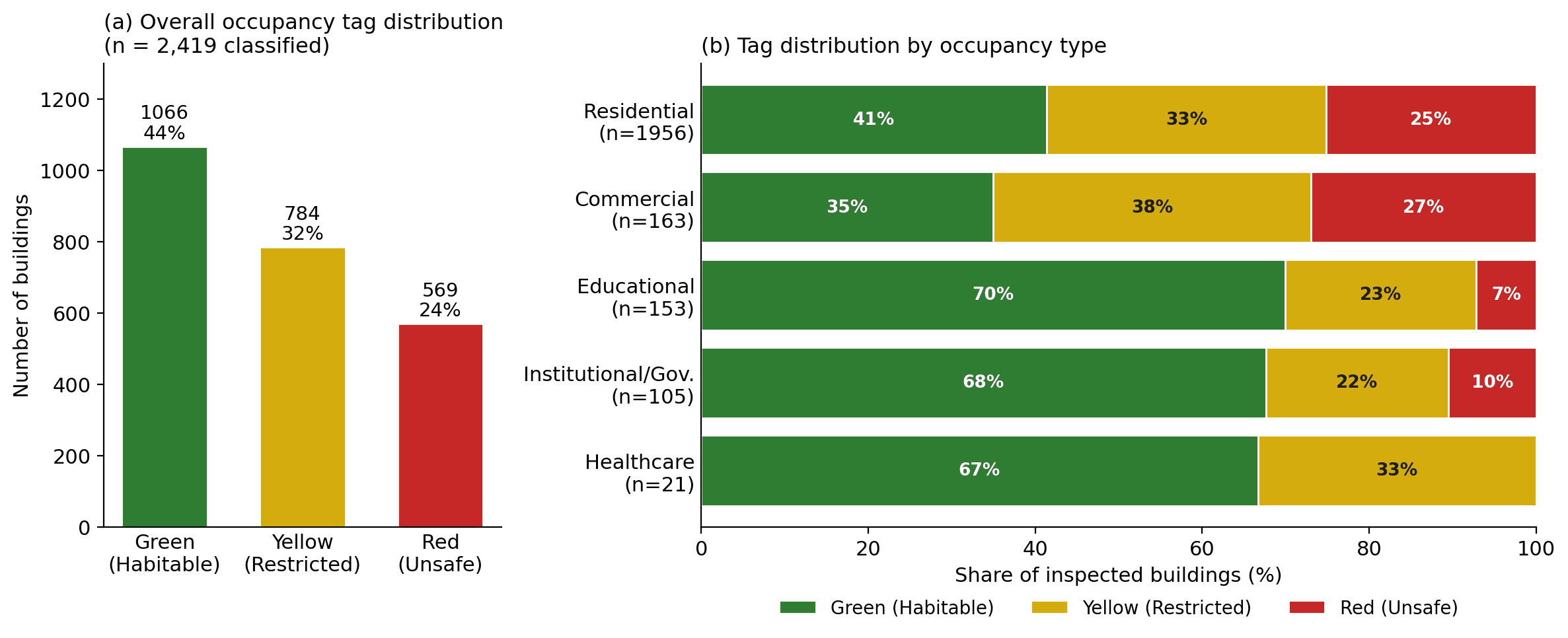
Figure 1. Post-earthquake occupancy tags for the city of Armenia from 2,460 inspections as of August 26th, 2026.
For anyone pricing, modeling, or reserving for earthquake risk, that is the finding worth carrying forward. Structural safety and operational continuity are not the same outcome. A view of risk calibrated on collapse and structural damage would have called 2026 correctly on fatalities and missed most of the loss. What materialized instead was disruption—displaced residents, closed schools, businesses unable to reopen, pressure on temporary shelter and social services—driven almost entirely by components that sit outside the structural system and are rarely captured in underwriting data. Figure 2 shows a typical example of how a building with no structural damage but extensive non-structural damage looks like.
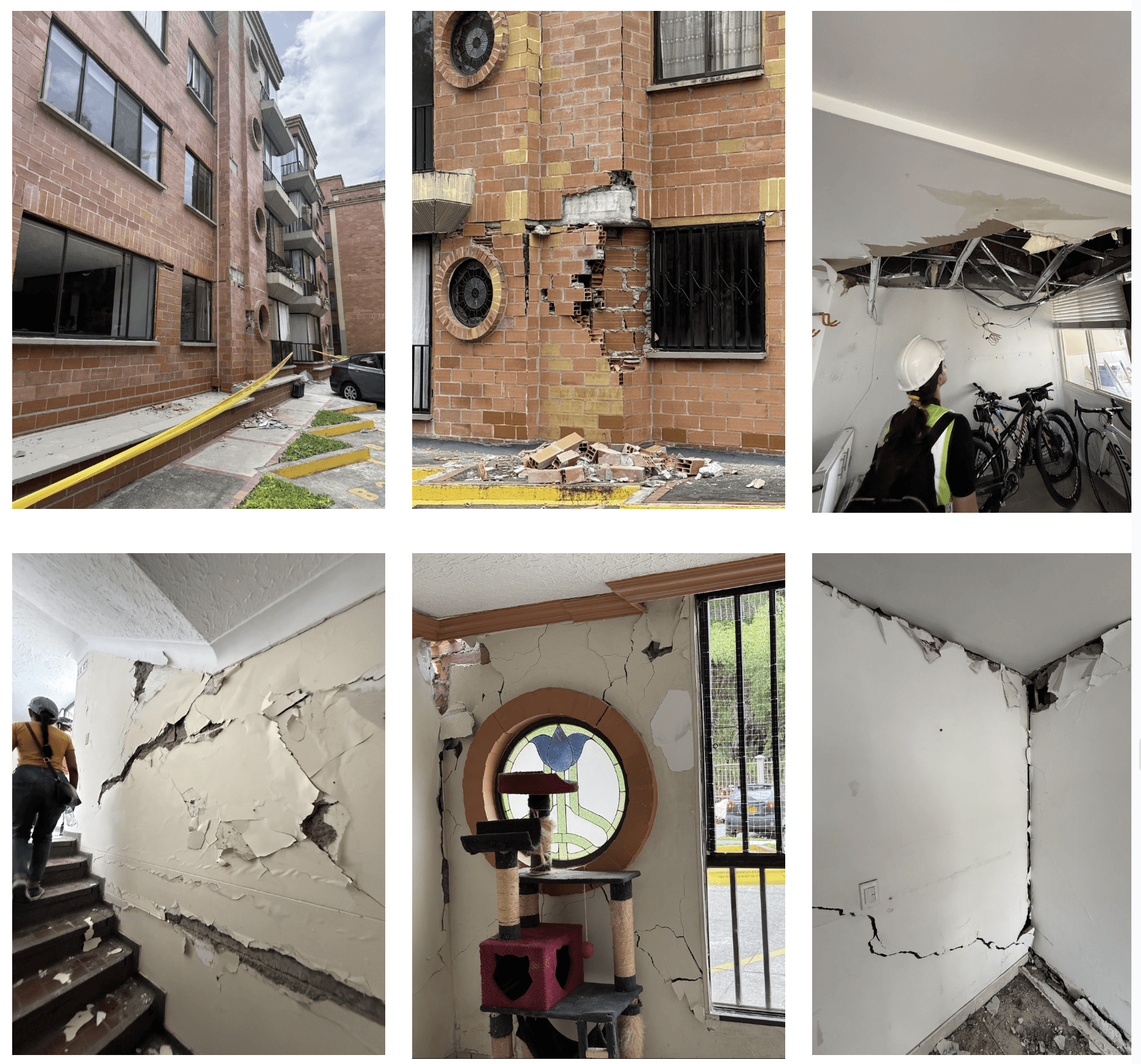
Figure 2. Typical damages in residential buildings: structure intact, but non-structural components so damaged that the building is inhabitable.
Three further observations from the fieldwork:
Construction vintage is a strong and usable signal. Among the residential complexes inspected in detail, the buildings tagged unsafe were consistently those built before 1999. Post-1999 buildings subjected to the same shaking came through with minor, repairable damage or none at all. One recently built development, sitting close to the local fault and near buildings that collapsed in 1999, showed no visible damage whatsoever.
Code compliance on paper does not guarantee performance in practice. The specific failures documented in 2026—walls with no separation from the frame, parapets with no anchorage — are the same failures documented in Armenia in 1999. Colombia's building code has required better since 1998. The gap is not in the rules; it is in what actually gets built. As the memory of a disaster fades, practice drifts back toward familiar shortcuts.
Recovery speed is itself a loss driver. The study documents real friction in the post-earthquake inspection effort: neighboring jurisdictions unable to coordinate, so that some buildings were inspected several times while entire residential areas went uninspected; five different inspection forms in simultaneous use; no certification system for post-earthquake evaluators and no liability protection for the engineers doing the work, which discouraged qualified people from volunteering. Every day a building waits to be assessed is another day of business interruption.
An important boundary on these findings
This report covers Armenia and Calarcá, and the conclusions should not be generalized beyond them.
That boundary matters more than it might appear, because Armenia and Calarcá are a special case. Both were devastated in 1999 and then very substantially rebuilt in the years that followed, under a national reconstruction program and a new building code. The favorable 2026 outcome documented here is, in large part, a measurement of what that rebuilding achieved. It is a story about a building stock that was renewed within living memory.
Most of the region affected in 2026 has no comparable history, and the difference is visible in the numbers. Figures compiled by Asocapitales as of the morning of August 13 record 96 deaths in Cali, 93 in Pereira, nine in Quibdó and six in Manizales—against none in Armenia.
The damage totals follow the same pattern. Manizales reported 1,449 collapsed homes, roughly 4,000 people displaced, and 24 public schools in critical condition. Quibdó reported 1,198 damaged homes. Cali reported 107 collapsed homes, 1,224 people injured and 111 still missing. Pereira reported 75 collapsed buildings and 260 people missing, with its bus terminal closed and Matecaña International Airport operating under restrictions. Armenia was not undamaged—174 people were injured and structures did collapse—but no one in the city was killed. These figures were preliminary when compiled and continue to be revised.
The lesson of this study is therefore not that Colombia performed well in 2026. It is narrower and, we think, more useful: where a city rebuilt to modern standards, the codes delivered life safety and protected the structures, and what remained was a disruption problem. Whether that holds for cities that did not go through Armenia's reconstruction is a separate question, and the early evidence suggests it does not.
And this was not the worst case for Armenia either
The 2026 earthquake came from a deep source more than 130 kilometers away, and the rupture propagated away from the city. It was, in effect, the less threatening of the two earthquake types the region faces.
The near-source scenario—a shallow rupture on the fault system directly beneath the city, the kind that occurred in 1999—remains untested against today's building stock. The shaking recorded in 1999 was roughly twice what the current code requires buildings to be designed for.
This matters because there are active proposals in Colombia to reduce the design earthquake demand in several regions, including the coffee region. The report's finding runs the other way. The design demand is only one layer of protection, and the other layers—enforcement, supervision, material quality, detailing—are demonstrably imperfect, as this earthquake showed in buildings of every age. Reducing the demand would remove margin that those other layers are already consuming. If the evidence points anywhere, it is that current requirements may be insufficient for a severe near-source event, not that they are excessive.
Read the report
The full technical report, including the ground-motion analysis, the code evolution review, the building-by-building inspection record, and the complete set of conclusions, is available here: https://doi.org/10.17603/ds2-6wqq-fd32
ResiQuant builds AI for catastrophe risk, and the quality of any risk model depends on what we actually understand about how buildings behave. Reconnaissance work like this is where that understanding comes from — not from theory, but from walking through damaged buildings in the week after an earthquake and writing down precisely what failed and why. The Armenia data set adds something rare: a direct, same-city comparison across twenty-seven years of code evolution, with instrumental records of both events. It is the kind of evidence the industry needs to move from modeling whether a building falls down to modeling whether it can be used the next morning.
We are grateful to the governments of Armenia and Calarcá for their collaboration throughout, and to the many Colombian engineers and students who volunteered during the response.
For questions about the study or its implications for catastrophe modeling, contact:
Juan Carlos Reyes Ortiz: jureyes@uniandes.edu.co
Juan Francisco Correal Daza: jcorreal@uniandes.edu.co
Francisco Galvis: galvisf@resiquant.ai
Carlos Oliveros: oliveros@resiquant.ai
Fernando López-Caballero: fernando.lopez-caballero@ecp.fr
Rodrigo León: r.leonl@uniandes.edu.co
Claudia Isabel Ramirez Angel: claudia@resiquant.ais
Andrea C. Riaño: andrea.riano@bsc.es
Carlos Lozano: c.lozanol@uniandes.edu.co
Rafael Fernández: rafael.fernandez@ucl.ac.uk
Laura Sofía Córdoba Sáenz: lcordob@ncsu.edu
How to cite:
Galvis, F., A. Riaño, L. Cordoba Sáenz, J. Correal Daza, R. Fernández, R. León, F. López-Caballero, C. Lozano, C. Oliveros, C. Ramirez Angel, J. Reyes Ortiz (2026). "Reconnaissance of the 2026 San José del Palmar Earthquake in Armenia, Quindío: A 27-Year Comparison with the 1999 Event", in Reconnaissance of the 2026 San José del Palmar Earthquake in Armenia, Quindío: A 27-Year Comparison with the 1999 Event. DesignSafe-CI. https://doi.org/10.17603/ds2-6wqq-fd32