ResiQuant co-founder and CTO Francisco Galvis sat down with our partners at Google Cloud to talk about how ResiQuant brings structural engineering to property underwriting.
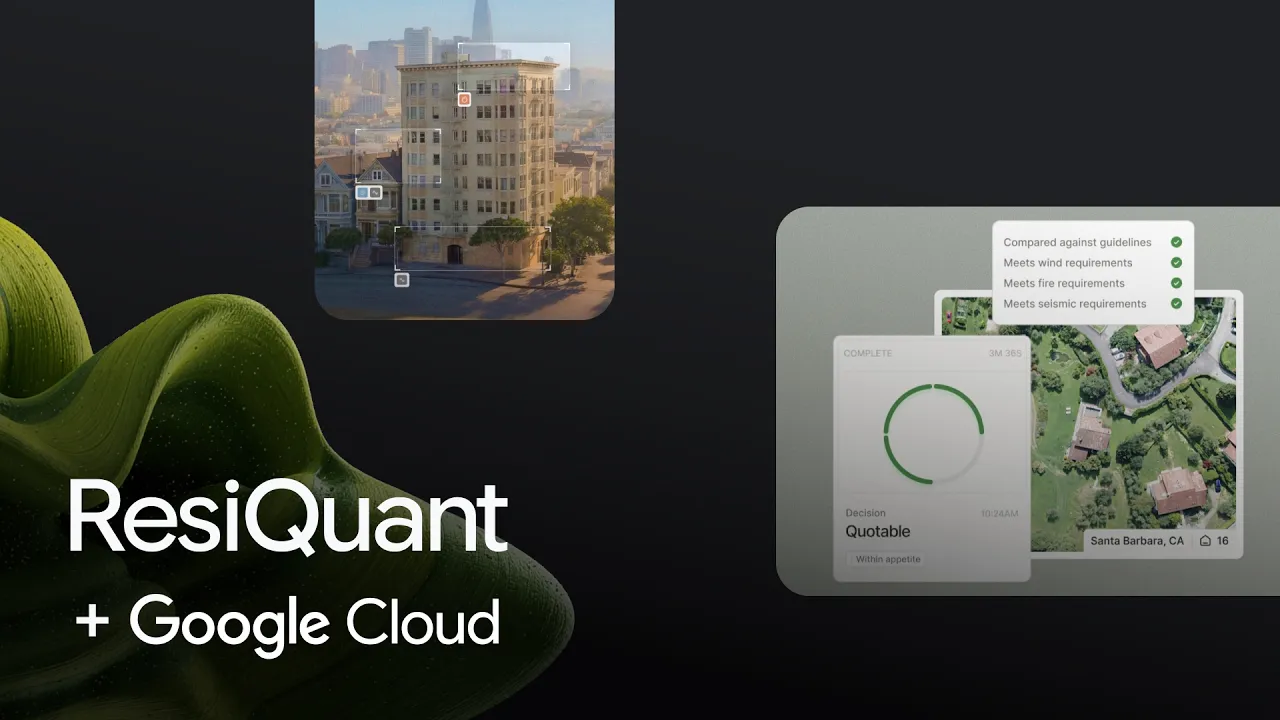
Speed and rigor, at the same time
In a softening property market, brokers expect quotes quickly, and the first credible quote often wins the account. At the same time, catastrophe losses continue to rise, so the cost of mispricing a building keeps growing. Overpricing a well-built building loses the account to a competitor. Underpricing a vulnerable one leaves the carrier holding risk it did not price for. Underwriting teams need both speed and engineering rigor on every submission, and adding headcount does not deliver both at scale.
Why underwriters need a structural engineer's assessment
To price a catastrophe-exposed building, an underwriter has to assess how its structure will perform in an earthquake, a hurricane, a flood event, or a tornado. That assessment depends on attributes like the structural system, the building code at the time of design, the roof-to-wall connections, and many other details. Underwriting teams rarely include a structural engineer to evaluate these characteristics, and SOVs often list them incorrectly or leave them blank.
ResiQuant co-founders Francisco Galvis and Omar Issa are Stanford structural engineering PhDs that have assessed damaged buildings after earthquakes and hurricanes. They built ResiQuant to apply that judgment to every building in a submission, in just a few minutes. As Francisco told Google Cloud, "We cannot improve what we cannot measure, and that's especially true in resilience."
Three AI agents
The ResiQuant platform is designed to remove the trade-off between speed and underwriting rigor. It runs three AI agents, each built to work the way a skilled underwriter or structural engineer works.
Submission AI
Submission AI turns any submission into standardized data for a catastrophe model, so underwriters start from a complete, clean file. It reads everything a broker sends, from the SOV, ACORD forms, and inspection and wind mitigation reports to BOR letters, expiring policies, loss runs and the broker’s email, and extracts every field an underwriter needs, along with the source of each value. It verifies every address, maps each field to the format the model expects, and resolves conflicts between documents using the source priority each team prefers. At intake, it also adds common hazard characteristics such as FEMA flood zone, distance to coast and distance to the nearest fault, and geocodes each location with the five leading geocoders in the market.
Its most important job is not losing anything.
A missing building is the hardest intake error to detect, because the output shows no sign of it. In our submission intake benchmark, Submission AI returned 98.7% of the buildings in the ground truth. Two frontier models called directly returned 90.0% and 79.6%.
Engineering AI
Engineering AI analyzes each building the way a structural engineer would, to streamline the review and validation of broker-submitted data, which is often incomplete or incorrect and can significantly affect pricing. It reviews the building information, public records and documents in the file, and evaluates that evidence in the context of the building code in force where and when the building was designed. From there it determines the construction class, the structural system, the roof attachment and the other inputs a catastrophe model needs.
It also shows its work. Every value comes with the engineering reasoning behind it, a clear confidence level and the evidence it relied on, so an underwriter can check any answer in seconds. Our published benchmarks test Engineering AI on real submissions against incumbent enrichment solutions in the insurance industry, most recently on roof covering and number of stories.
Clearance AI
Clearance AI is the underwriting assistant that knows your guidelines by heart and applies them the same way on every submission. It runs the appetite and guideline checks, along with operational checks such as clearance, renewals and broker appointments. It flags exceptions, moves bindable files to the top of the queue and keeps an audit trail of every decision.
It also handles the routine correspondence with brokers: requesting missing files on incomplete submissions, sending hard declines, and confirming when an account has been cleared and reserved.
Impact on insurance pricing
A catastrophe model can only estimate loss from the building characteristics in its input. When the SOV gets the structure wrong, that error goes straight into the premium, the reinsurance purchase and the capital held behind the book. Our goal is to give every underwriting team the structural engineer's assessment it usually does not have, so carriers can see their real exposure, price each risk on its merits, and give property owners coverage that matches the perils they actually face.
To quantify how that assessment changes modeled loss, we ran a 1,000-location, $8.2B hurricane-exposed book through a catastrophe model twice. The first run used the submitted SOV, and the second used Engineering AI's building data. Correcting the submitted construction class and year built where they were incorrect changed modeled loss more than any other field. That is the impact Francisco described to Google Cloud, and it is why we built ResiQuant, to bring structural engineering fact to every underwriting team.
Thank you to the Google Cloud team for telling this story.
To see what Engineering AI can find in your own submissions, book a demo.