In January 1994, the Northridge earthquake tore the roofs off tilt-up warehouses across the San Fernando Valley. Steel anchorage straps fractured at the net section. Pilaster tops failed. Subpurlin connections pulled out of concrete walls. Many of those buildings had been designed to the 1976, 1985, or 1991 Uniform Building Code — the very vintages that today's seismic underwriting heuristics treat as "modern enough."
That is the tension this article resolves. A rule of thumb still in wide use across E&S property — any tilt-up built after 1976 is properly anchored — collapses under three pressures: code adoption lag, the magnitude of force-level changes since 1976, and the way seismic and wind hazard maps have been redrawn under buildings already standing.
Why Wall-to-Roof Anchorage Decides the Loss
Tilt-up buildings — formally rigid wall–flexible diaphragm (RWFD) structures — are the dominant form of warehouse, distribution, and big-box construction in the United States. The Tilt-Up Concrete Association estimates more than 10,000 are erected each year. The walls are heavy precast concrete panels; the roof is a lightweight wood-panel or bare steel deck diaphragm. The connection between the two, the out-of-plane wall anchorage, is the load path that keeps the walls upright in an earthquake or a windstorm.
When that connection fails, the wall detaches from the roof, the roof loses lateral support, and a partial or complete collapse follows. FEMA P-1026, Seismic Design of Rigid Wall–Flexible Diaphragm Buildings catalogs this same failure mode in every major California earthquake since 1971: San Fernando, Morgan Hill, Whittier Narrows, Loma Prieta, Landers/Big Bear, and Northridge. The 2018 paper by Wade et al., Seismic Risk Assessment of Tilt-Up Buildings Using the FEMA P-58 Method, reaches the same conclusion through nonlinear analysis: in tilt-ups designed before the 1997 UBC, anchorage failure is the dominant driver of loss.
For an underwriter, this means the question is rarely whether a tilt-up is "good" or "bad" construction. The question is whether the wall-to-roof connection meets a force level appropriate to the hazard at that site, designed to a code that was actually in effect when the building was permitted, and built without the field defects that defeat any plan-stamp date.
How Much the Design Force Has Changed Since 1976
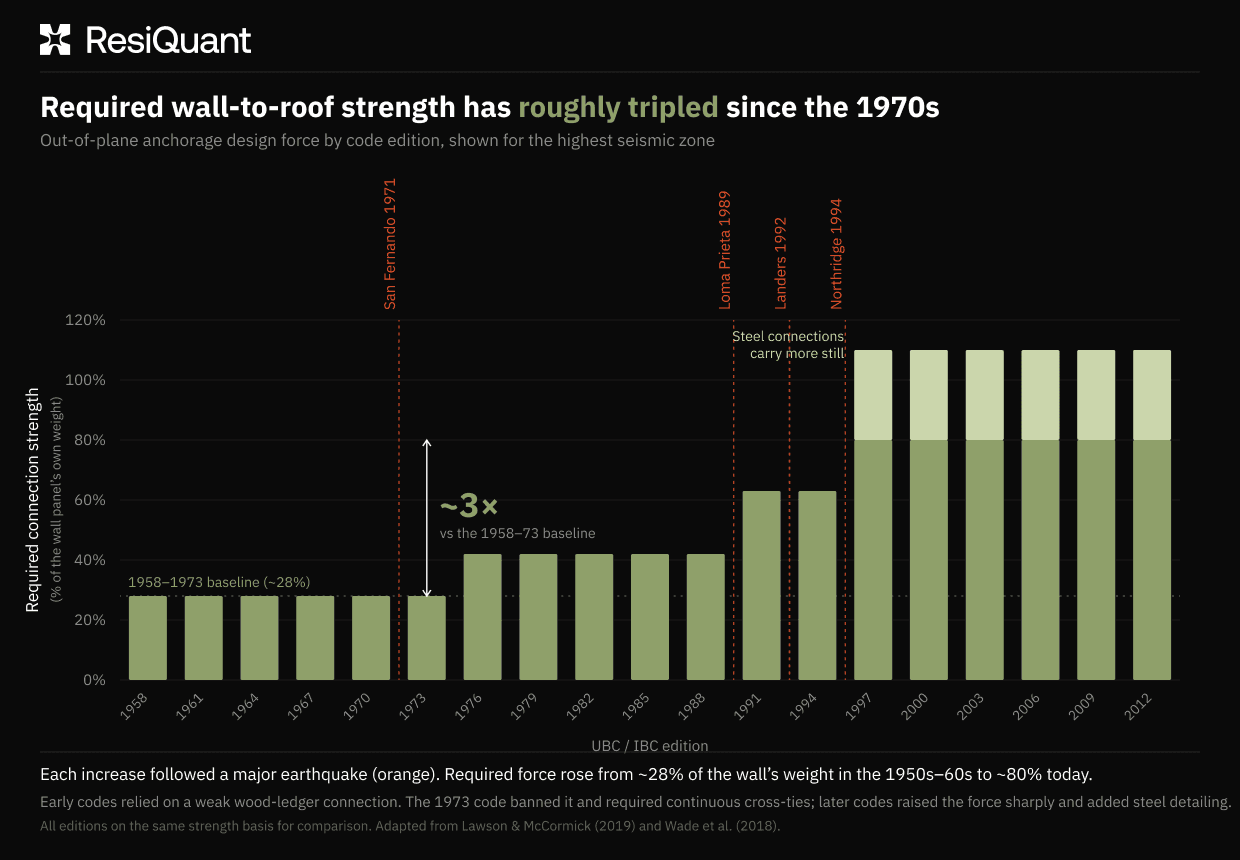
The chart above shows how much the requirement has changed. Each bar is one code edition, and its height is how strong the wall-to-roof connection had to be, measured as a share of the wall panel's own weight.
The early decades were nearly flat. Before 1973 the wall was tied to the roof through the wood ledger in a way that bent it across the grain. That detail fails easily and carried no real design force. After the 1971 San Fernando earthquake the 1973 code banned it and required continuous ties between the walls and the roof.
From there the force rose in steps, and each step followed a damaging earthquake. The 1976 code raised it by half. The 1991 code raised it by half again. The 1997 code, written after Loma Prieta, Landers, and Northridge, raised it once more and added tougher rules for steel connections and long roofs.
The gap between eras is large. A connection designed today must resist close to 80% of the wall's own weight. One built to mid-1970s or 1980s code was designed for about half that. One from before 1973 was designed for about a third.
The modern code also penalizes long buildings, where a long-span roof can require up to twice the force of a short one. None of this tracks neatly with age, which is why year built is a weak proxy for safety. Wade et al. sort tilt-ups into three code eras whose expected losses depend heavily on the era for which the building was designed.
Code Adoption Lag and the Geography Problem
The "post-1976" heuristic assumes the 1976 UBC was the operative code in 1976. It usually wasn't.
The UBC became law only when a state or local government adopted it, and the lag could be substantial. San Jose didn't adopt the 1976 UBC until 1978. California makes the rule shakier still, since the statewide code referenced the 1979 UBC as late as October 1985, so a tilt-up built anywhere in the state in the mid-1980s, including the Central Valley, was likely designed to 1979 anchorage forces, a full cycle behind the code then in print.
Outside the western states, the picture is sharper. The UBC governed only in the West; the Standard Building Code governed the Southeast, and BOCA governed the Northeast and Midwest. Neither contained UBC-equivalent tilt-up wall-anchorage provisions during the 1970s through the 1990s. Charleston, South Carolina operated under the Standard Building Code and did not get full seismic detailing language equivalent to the 1997 UBC until it adopted the IBC 2000 in 2001. A tilt-up built in Memphis in 1985 was not designed to the 1976 UBC. It was designed to SBCCI provisions that did not contain the same out-of-plane anchorage requirements at all.
The IBC unified the three legacy model codes starting in 2000, but state adoption rolled out unevenly through 2008. A vintage-based underwriting rule that does not pair year-built with the actual code adopted at the building location does not apply across large parts of the country.
Hazard Maps Have Moved Under the Buildings
Even when the original design was code-compliant, the hazard the building now faces may have grown.
The USGS National Seismic Hazard Model has been updated multiple times since the maps that informed the UBC zones. The 2018 update produced site-by-site changes of up to +80% or −60% in probabilistic ground motion, with shifts up to ±64% in the Central and Eastern U.S. driven by new ground-motion models.
A 1985 Tacoma tilt-up was designed to roughly a third of the wall anchorage force the same building would need under today's code, and probably less, because Tacoma is one of the places where the hazard itself also grew. The Cascadia subduction zone was not treated as a design source until the 1996 USGS maps, so today's force is computed from both a higher ground motion and a stricter formula.
Wind tells a parallel story. In most U.S. tilt-up markets outside California and the Pacific Northwest, wind, not seismic, governs out-of-plane wall anchorage. ASCE 7-16 increased Components and Cladding pressures for many tilt-up roof and wall configurations relative to ASCE 7-10. A 1995-vintage tilt-up in coastal Florida or the Texas Gulf Coast is under-anchored against current wind code regardless of any seismic question.
The Opportunity Hidden in the Same Analysis
Anchorage adequacy is a function of three things: the design force required by the governing code at the time of permit, the hazard at the site today, and the field execution of the connection itself. A 1985 tilt-up in interior Indiana — low seismic, moderate wind, no Cascadia or New Madrid proximity — carries a materially different exposure than a 1985 tilt-up in San Bernardino or Memphis. The underwriting opportunity is to price that distinction, rather than treat all post-1976 stock as a single bin.
Carriers who can stratify a tilt-up portfolio by era, hazard, code adoption, and connection adequacy can confidently write risks competitors avoid, and avoid risks competitors mistakenly take in. That advantage compounds at the portfolio level: better selection in high-hazard zones, fewer surprises in markets where the era-only rule was never calibrated to local code history.
How ResiQuant Can Help
ResiQuant's Engineering AI performs a virtual structural inspection of every building in a submission, with wall-to-roof anchorage as one of the specific elements examined for tilt-up and RWFD construction. The output is not a score. It is a finding, with the structural reasoning behind it — mapped directly onto the three-part diagnostic this article describes: the governing code at the building's location (not the model code publication date, but the adopted code in that jurisdiction), the current hazard demand at that site under updated USGS and wind maps, and the physical condition of anchorage and pilaster details. For E&S carriers writing catastrophe-exposed property, that engineering-grade view of anchorage adequacy replaces a vintage rule that was never built for the country outside California with a building-level read that holds up in a reinsurance treaty conversation.
What to Do With This
The "post-1976 = properly anchored" rule was a reasonable first-generation heuristic in California. It is not defensible as a portfolio screen in 2026. The design force has roughly doubled since 1976, and more than tripled since the early 1970s. The model code in question never applied across most of the country, and the hazard maps have moved upward in many of the markets where tilt-ups concentrate.
E&S carriers writing tilt-up and RWFD risks should pair every era-based question with the actual code adopted at the location, the current seismic and wind demand at the site, and a building-specific read on the anchorage itself. The carriers who do this can price the difference between a 1985 Indiana warehouse and a 1985 San Bernardino warehouse — a distinction the era-only heuristic erases entirely. That is where the underwriting edge is, and where the era-only rule leaves money on the table in both directions.